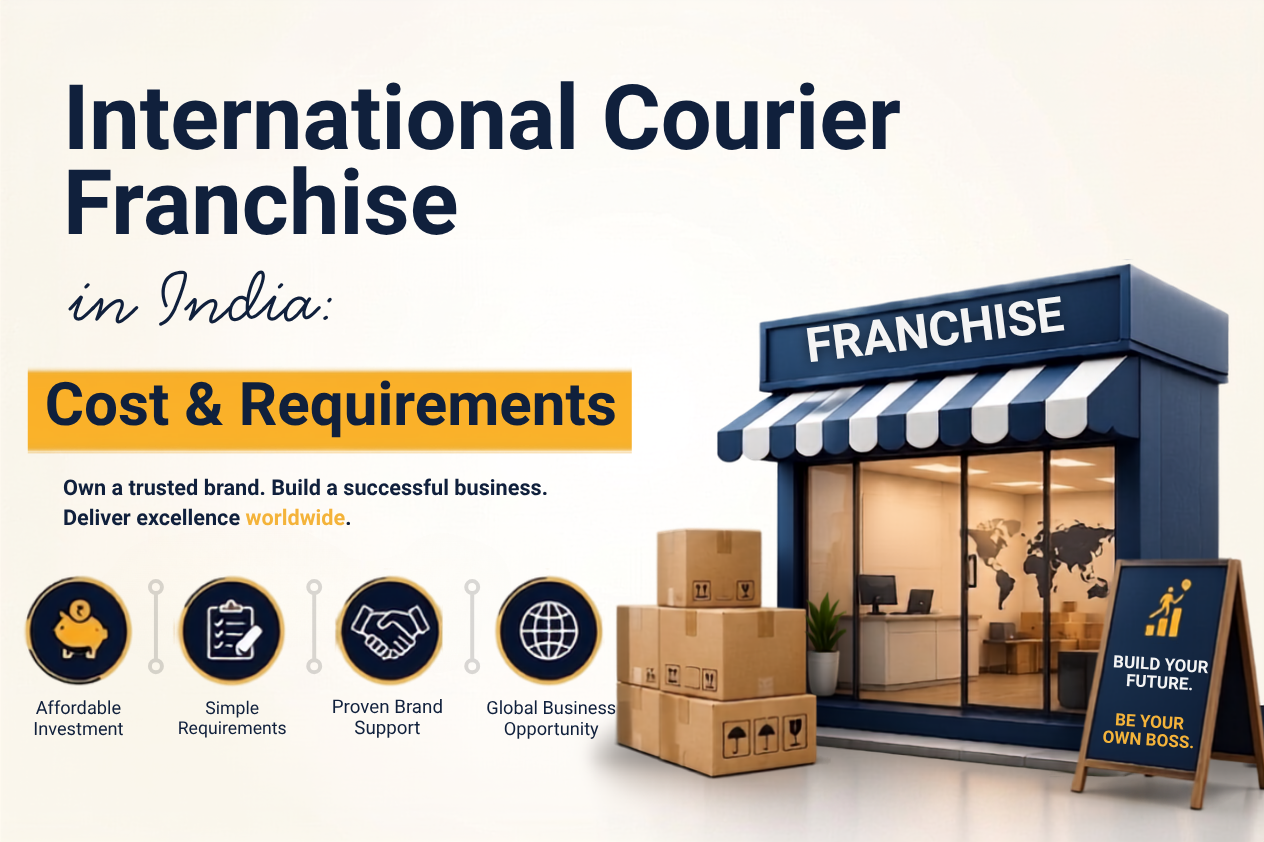
International Courier Franchise in India: Cost & Requirements
International Courier Franchise in India: Cost & Requirements
An
international courier Service franchise is a licensed local outlet of an
established courier brand that handles pickup, packing, and dispatch of parcels
abroad, while the parent network manages customs clearance, tracking, and
global delivery. In India, franchise requirements can vary based on the
location, business format, and operational needs. It suits hands-on operators,
not passive investors.
India's cross-border trade grows every year, and so does the number of families, students, and businesses sending parcels abroad. That single fact is behind one of the steadiest small-business opportunities in the country right now: the international courier franchise. Here's what to know before signing anything.
What Is an International Courier Service Franchise?
An
international courier Service franchise is a licensed local outlet of an
established courier brand, authorized to accept, pack, and dispatch shipments documents,
parcels, excess baggage, commercial consignments to destinations across the
world.
You're
not building a logistics network from scratch. You're plugging into one that
already exists: the brand's global partnerships, customs clearance
relationships, tracking systems, and delivery infrastructure. Your job is to
run the local operation pickup, packing, customer service, and dispatch while
the parent network handles everything once the shipment leaves your city.
This
distinction matters. A courier Service franchise isn't a shipping company you
build; it's a service business you operate. That changes what skills you need
and what risks you're taking on.
How Much Does It Cost to Start One?
Courier franchises are relatively capital-light compared to most retail or F&B franchises no warehouse or delivery fleet required.
| Cost component | Typical range / detail |
| Franchise fee | Varies based on location, franchise format, and business requirements |
| Additional setup costs | Retail-format space, packing materials, signage, working capital |
| Agreement term | 2 years, renewable - ideally without extra renewal charges |
| Physical footprint | A shop-sized location with a counter, packing area, and storage |
Get clarity on the franchise agreement term, what support is included, and how commissions or margins are structured on each shipment before you sign.
Why This Sector Is Worth a Serious Look
Three forces are driving demand, and none of them are slowing down.
| Demand driver | Why it holds up |
| Growing diaspora | Millions of Indian families have relatives working or studying in the US, UK, Canada, Australia, the Gulf, and beyond. Festivals, weddings, and homesickness create steady demand for sending food, clothes, gifts, and documents overseas - relationship-driven demand that resists economic slowdowns. |
| E-commerce and small business exports | Handicraft sellers, D2C brands, and small manufacturers increasingly ship product samples and orders internationally, and need affordable, reliable courier partners rather than enterprise freight solutions. |
| A gap below the big players | Large multinational logistics companies dominate the enterprise and B2B segment, but their pricing and branch density don't always serve individual customers and small businesses well outside metro cities. Established Indian international courier brands have built scale in that gap, often at 30–50% lower cost than the large global players, while still covering 200+ countries. |
Put
together, this is a business with real, recurring local demand and a customer
base that doesn't disappear when one industry has a bad quarter.
What the Business Actually Involves, Day to Day
Strip away the branding, and running a courier franchise comes down to a few repeatable operations:
- Pickup and intake - Collecting parcels from customers, either walk-in or scheduled home pickup.
- Packing and documentation - Professional packing (a genuine differentiator, since damaged shipments are the fastest way to lose a customer) plus customs paperwork.
- Booking and dispatch - Entering the shipment into the network's system, weighing, pricing, and handing off to the logistics chain.
- Tracking and customer communication - Keeping customers updated until delivery, and handling the inevitable questions about customs delays or last-mile issues.
- Local marketing - Because even with a recognised brand name, local awareness and trust are built branch by branch.
None of
this requires a warehouse or a fleet of trucks. Most franchise outlets run out
of a modest retail-format space.
What to Evaluate Before You Sign
Every franchise looks appealing in a pitch deck. Here's what separates a genuinely good opportunity from one that will drain your capital.
- Network reach. Ask specifically how many
countries the brand ships to, not just "worldwide." A brand that
genuinely delivers to 200+ countries with established customs
relationships in each major corridor (USA, UK, Canada, Australia, Middle
East) will save you from constant service gaps.
- Branch density and track
record. A
brand with 400+ operating branches across 190+ cities has already solved
the hard early problems - systems, training, vendor relationships - that you'd otherwise be discovering
yourself. Longevity matters too; a brand operating for over a decade has
weathered customs policy changes, currency swings, and at least one global
disruption.
- Real customer proof, not
just marketing copy. Look for verifiable customer reviews that
mention specific things: delivery timelines actually met, damage-free
packing, responsive tracking. Reviews describing 3–7 day delivery to the
US or UK, intact parcels, and helpful branch staff tell you far more than
a franchise brochure does.
- Support systems. Does the franchisor provide
branded packing material, a booking and tracking platform, marketing
support, and 24/7 operational support? A brand that treats franchisees as
genuine partners - not just fee collectors - will invest in these systems
visibly.
Pricing competitiveness. Since a meaningful part of this business's appeal to customers is being 30–50% more affordable than the global giants while still delivering reliably, make sure the brand you're evaluating can actually back that positioning with real service quality, not just price.
Who Should and Shouldn't Consider This Business
Good fit: Someone comfortable with
front-line customer service, detail-oriented enough to manage documentation and
customs requirements without errors, and willing to build a local reputation
over 12–24 months rather than expecting overnight scale. It particularly suits
people in cities with a strong NRI or diaspora population, near universities
with international student populations, or in commercial hubs with small
exporters and manufacturers.
Not a
good fit: Anyone
looking for a purely passive investment. Even with a strong franchise system
behind you, the first year is about building local trust, and that requires
your active presence.
Conclusion
An
international courier Service franchise sits in a sweet spot: recurring,
relationship-driven demand; a proven and provided operating system; relatively
low capital requirements; and a real service gap between global logistics
giants and everyday customers. It's not a get-rich-quick play; it's a steady, service-driven small business
with a growth curve tied directly to how well you execute pickup, packing, and
customer trust at the local level.
If you're
serious about this space, spend real time with the franchise's existing
partners before you commit. Ask how their first year actually went, not just
how the brochure describes the opportunity. The courier business, more than
most franchises, lives or dies on operational discipline, and the franchisees who've already been
through it are the most honest source you'll find.